
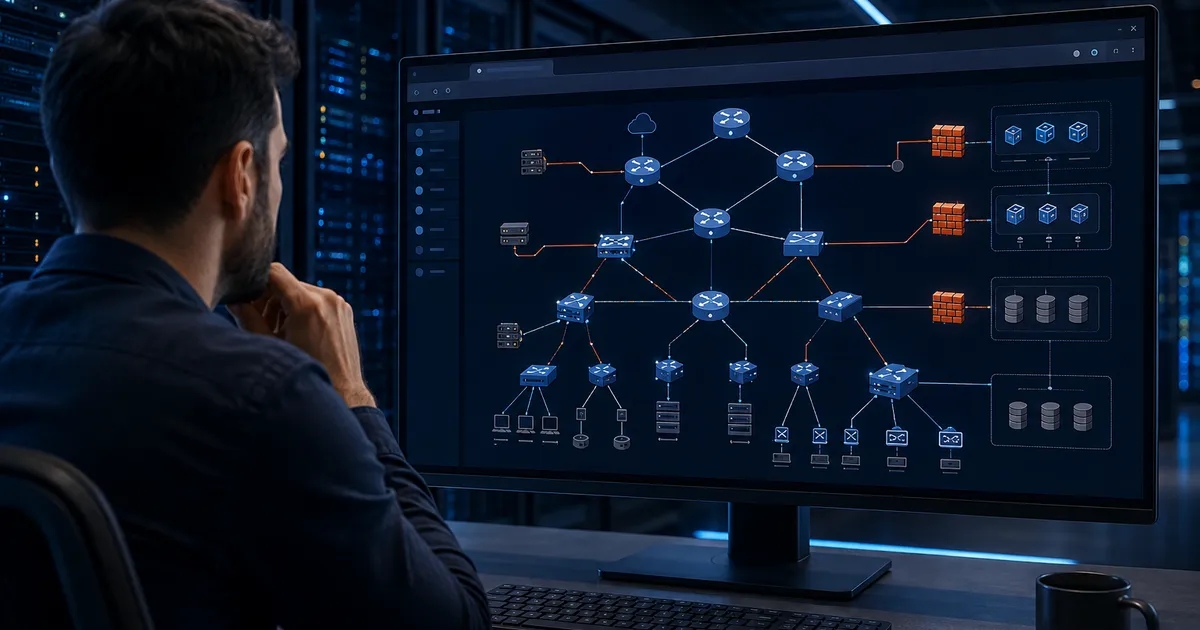
Many networking courses end with a familiar gap: learners can describe protocols correctly but hesitate when they must diagnose a live topology. Slides present clean diagrams, while production networks contain overlapping routes, asymmetric paths, incomplete documentation and devices from several vendors.
The problem is not a lack of theory. It is the absence of repeated practice under conditions that resemble real operations. A learner needs to configure a device, observe the result, make a mistake, collect evidence and restore service. That feedback loop turns remembered commands into operational judgment.
A realistic Network Lab should support multi-vendor images, virtual machines, traffic flows and controlled failure scenarios. It should also preserve isolation so one learner cannot affect another team or a production environment. Browser-based consoles make the lab accessible without requiring every participant to own powerful hardware.
Start with a clear outcome rather than a large topology. For example, ask learners to maintain connectivity during a failed uplink, then define the expected routing state, monitoring signals and recovery time. Add complexity only after the team can explain the evidence from the previous stage.
Measure training by what participants can troubleshoot, document and repeat, not by the number of slides completed. A well-designed lab creates durable skills because engineers learn both the normal state and the warning signs that appear before an outage.
The gap between knowing a command and operating a network
Certification material often teaches the correct configuration for an isolated feature. Production work asks a different question: which feature, device or dependency is responsible for the observed symptom? Engineers must form a hypothesis, select evidence, distinguish cause from coincidence and recover service without creating a second incident. That reasoning only develops through repeated troubleshooting, not through command memorization alone.
A realistic exercise should include incomplete information and more than one plausible cause. For example, loss of connectivity may result from a failed route, an incorrect VLAN, a security policy, DNS or an endpoint gateway. Learners should inspect interface state, tables, logs and packet flow in a defined order. The instructor can then evaluate the process as well as the final configuration.
Build scenarios around operational outcomes
Each scenario needs a normal state, a business impact, one or more injected faults and measurable success criteria. A routing lab might require branch connectivity to recover within a target time after an uplink failure. A firewall lab might require publishing an application while preserving segmentation and producing logs that prove the intended policy. Outcomes keep the exercise focused when the topology contains many devices.
Difficulty should progress deliberately. Begin with device access and baseline verification, then add configuration tasks, predictable failures and finally ambiguous incidents involving several layers. Keep a known-good snapshot so the environment can be restored quickly. Learners gain more from running the same investigation twice with different evidence than from spending an entire session rebuilding a broken lab.
Design the lab platform for repeatable learning
Resource sizing must account for device image behavior, not only node count. Firewalls, Windows servers and traffic generators may consume far more CPU and RAM than lightweight virtual routers. Storage performance affects boot time and snapshot operations, while concurrent isolated copies determine the true class capacity. A pilot with representative scenarios is the safest way to validate the package.
Access control also matters. Separate student environments, use time-limited accounts, protect the management plane and avoid exposing device consoles directly to the Internet. Browser consoles and VPN access reduce endpoint requirements while preserving isolation. Image licensing and permitted use should be documented so the training environment remains technically and legally sustainable.
Measure whether training changes real behavior
Assessment should record time to identify the affected layer, evidence collected, quality of the rollback plan, recovery time and clarity of the incident note. A learner who restores service by guessing has not demonstrated the same capability as one who proves the cause and can repeat the fix. Team exercises can also measure communication, escalation and handover during an outage.
After each lab, conduct a short review of what was expected, what happened and which signals were most useful. Convert recurring mistakes into checklists or follow-up scenarios. Over time, the lab library becomes an operational knowledge base that supports onboarding, certification preparation, change rehearsal and incident readiness across the engineering team.
Bình luận
Đang tải bình luận…