
Virtual servers are the right default for many workloads because they deploy quickly and scale in small increments. Bare Metal becomes relevant when resource sharing, virtualization overhead or limited hardware access prevents the application from meeting a predictable requirement.
Look for sustained CPU demand, large memory footprints, sensitive storage latency, high packet rates or licensing tied to physical sockets. Databases, virtualization hosts, private cloud platforms and high I/O applications are common candidates, but measurement should drive the decision.
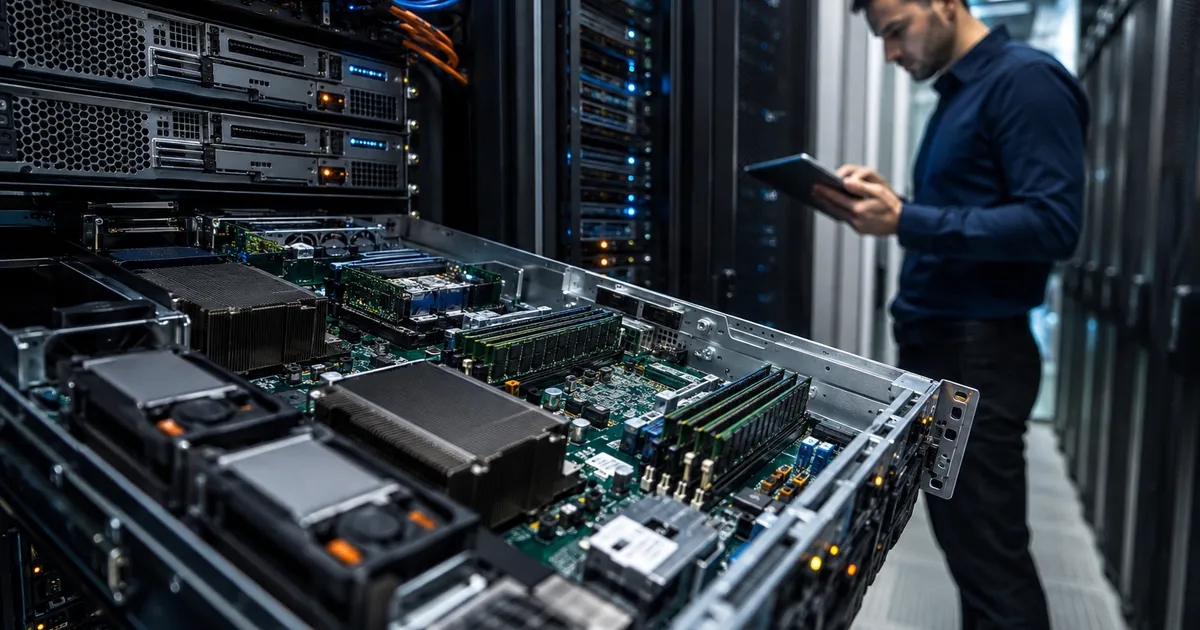
Dedicated hardware provides consistent access to CPU, ECC RAM, storage controllers and network interfaces. It also allows custom RAID, local SSD and HDD combinations, hypervisor choices and security controls that may not be exposed by a standard VPS.
The tradeoff is operational responsibility. Capacity changes take longer, failed components require replacement and redundancy must be designed explicitly. Colocation adds reliable power and connectivity, but backup, monitoring and recovery procedures still belong in the architecture.
Before migrating, benchmark the real workload and define success criteria for latency, throughput and recovery. Bare Metal is valuable when it solves a measured constraint or control requirement, not simply because a physical server appears more powerful.
Identify whether virtualization is the real constraint
High application response time does not automatically mean the VPS platform is insufficient. Check guest CPU, steal or ready time, memory pressure, disk latency, network packet rate and application metrics. Database locks, inefficient queries or external services can remain slow after migration to faster physical hardware.
A dedicated server becomes compelling when demand is sustained, predictable and sensitive to shared-resource variation, or when the workload needs hardware access unavailable in a standard VPS. Examples include large databases, virtualization hosts, storage-intensive services, private cloud nodes, packet-processing systems and software licensed by physical socket.
What Bare Metal changes
Bare Metal gives the workload direct, consistent access to processors, ECC RAM, storage controllers and network interfaces. The operator can choose firmware, BIOS policy, hypervisor, RAID, local SSD and HDD mix, NIC layout and security controls. Performance isolation is stronger because another tenant cannot consume the same physical host resources.
Dedicated hardware does not remove virtualization; many Bare Metal servers run a private hypervisor to host several controlled VMs. The difference is ownership of the capacity and scheduling domain. This can improve predictability and support custom networking, but the organization must size the complete host and plan failure recovery for all dependent VMs.
Account for new operational responsibilities
Physical components fail and capacity cannot be expanded as instantly as a virtual plan. Define spare or replacement arrangements, remote management, firmware maintenance, power redundancy and out-of-band access. RAID protects availability from some disk failures but is not a backup; data still needs independent copies and restore testing.
Colocation provides controlled power, cooling and connectivity, but responsibility boundaries must be explicit. Determine who replaces a disk, responds after hours, monitors hardware sensors, manages the operating system and restores applications. A physical server without these processes may deliver higher benchmark performance but lower service resilience.
Plan and test the migration
Define success criteria for transaction latency, throughput, batch duration, concurrent users and recovery. Test the proposed CPU, RAM, storage and NIC combination with representative data. Include backup, security scanning and peak traffic so the benchmark reflects production rather than an empty system.
Create a migration sequence, synchronization method, cutover window, validation checklist and rollback point. Monitor the application before and after using the same metrics. Bare Metal is justified when it removes a measured limitation, supports a control requirement or improves lifecycle economics—not simply because dedicated hardware appears more powerful.
Bình luận
Đang tải bình luận…