

Network topology is the physical or logical arrangement of devices and connections in a network. Choosing the right topology affects performance, scalability, resilience and the effort required to operate the environment.
Common models include star, ring, bus, mesh and hybrid topologies. Modern enterprise networks normally combine several models: access devices connect in a star, core paths use redundancy, and virtual overlays create flexible logical connections on top of the physical infrastructure.
A useful lab should let learners observe both layers. Start with a small topology, document addressing and routing decisions, then introduce redundant links, failure scenarios and monitoring. This makes the relationship between architecture and day-to-day operations much easier to understand.
Physical and logical topology are different design views
Physical topology describes where devices, cables, wireless links, racks and power domains actually exist. Logical topology describes how traffic moves through VLANs, routing domains, overlays, security zones and application paths. A network may look like a simple star on a floor plan while operating as several isolated logical networks with redundant gateways and policy-controlled connections. Both views are required because a physical cable failure and a logical routing failure produce different evidence and recovery procedures.
Create separate diagrams for cabling, Layer 2, Layer 3, Internet and WAN connectivity, security zones, management access and critical application flows. Trying to place every detail on one diagram usually creates a picture that nobody can maintain. Each diagram should have a purpose, an owner, a revision date and enough identifiers to connect it to interface descriptions, IP address management and configuration backups.
Choose topology from failure behavior, not appearance
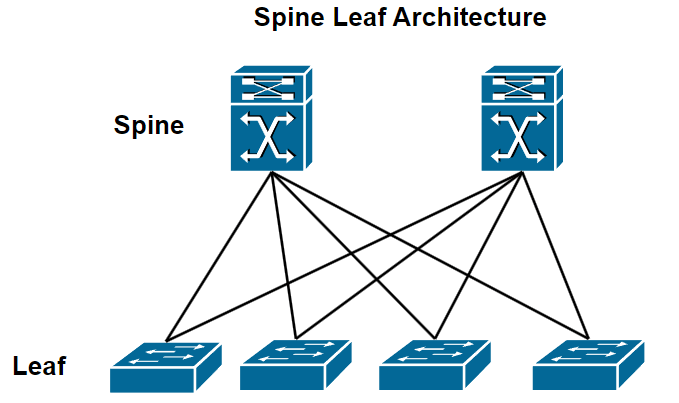
Star topology is easy to operate but makes the central switch or gateway important. Ring designs can provide predictable alternate paths but require loop prevention and convergence testing. Full mesh improves path diversity at the cost of ports, circuits and operational complexity. Leaf-spine architecture provides consistent east-west paths for Data Center workloads, while hub-and-spoke WAN designs simplify control but may send branch-to-branch traffic through a central location.
The correct choice depends on the business service. Define how many component failures the network must tolerate, how quickly traffic must recover and whether sessions can survive a path change. A small office may accept a single access switch but require dual Internet links for cloud applications. A virtualization cluster may require redundant switching, power and storage paths because a short interruption affects many systems at once.
Translate business requirements into a topology
Begin with users, locations, applications, traffic direction and security boundaries. Record peak concurrent users, large data transfers, voice or video sensitivity, remote access, public services and dependencies such as DNS, Active Directory and cloud gateways. This prevents a design from being driven only by the number of ports or a preferred equipment model.
Next, assign capacity and resilience targets to each important path. Include uplink oversubscription, expected growth, Power over Ethernet demand, routing table scale, firewall throughput with security features enabled and wireless client density. Reserve space for monitoring, management and backup connectivity. A topology becomes implementable only when the diagram, addressing plan, equipment capability and operational process agree.
Validate the design before production
Recreate the critical paths in a Network Lab and test normal traffic, link loss, device restart, routing withdrawal, incorrect VLAN assignment and firewall policy changes. Measure convergence time and confirm that monitoring reports the same failure users would experience. Testing should also verify that the recovery path has enough capacity; a redundant link that becomes saturated during failover is not effective redundancy.
Before handover, produce an as-built diagram, interface inventory, IP and VLAN plan, routing summary, security rule ownership, backup location and rollback procedure. Schedule periodic reviews because topology changes whenever a new branch, SaaS dependency, VPN, server or wireless segment is added. A maintained topology is an operational control, not merely a document created for a project meeting.
Bình luận
Đang tải bình luận…